How to understand the different titles of UX Designers

Source: NetMagazine

Among the most asked questions in Quora related to UX Design, a good chuck is about the differences of titles and roles related to the practice.

First of all, when you look into the demarcation of roles today, basically, you can divide designers into two hemispheres: creative designers, and experience designers. The first related more with Marketing activities, while the latter more into, you guessed it right, digital product development, and this is where most UX designers sit in today’s digital startups.

UX Designer Roles

Note: by “UX Designers” I also imply any roles that contribute to the creation of a delightful User Experience, i.e.: UX Researcher (UXR), Information Architect (IA) Interaction Designer (IXD), Visual Designer (VD) or UI Designer (UID), Product Copywriter (PCW) or UX Writer (UXW), Product Copy Editor (PCE), and UI Developer (UI Dev).

Product Designer

In a more agile setting, where designers are distributed into different teams, the role of “Product Designer” usually encompasses all of those specialization mentioned earlier. Alternatively, some companies label this the end to end role as “UI/UX Designer” which is a misnomer as it treated UX activities as simply creating wireframes, a prerequisite for UI activities to create the actual design; an oversimplification.

If you should differentiate between roles, then Interaction Designer (IXD) are those that produce product design concepts, i.e. how the product works, through identifying which intent to be rendered, and how it should be rendered. User Interface Designer (UID) or Visual Designer (VD) are those that translate the design concept into mockup as the representation of the end product, plus the necessary assets to be developed by the Engineering team.

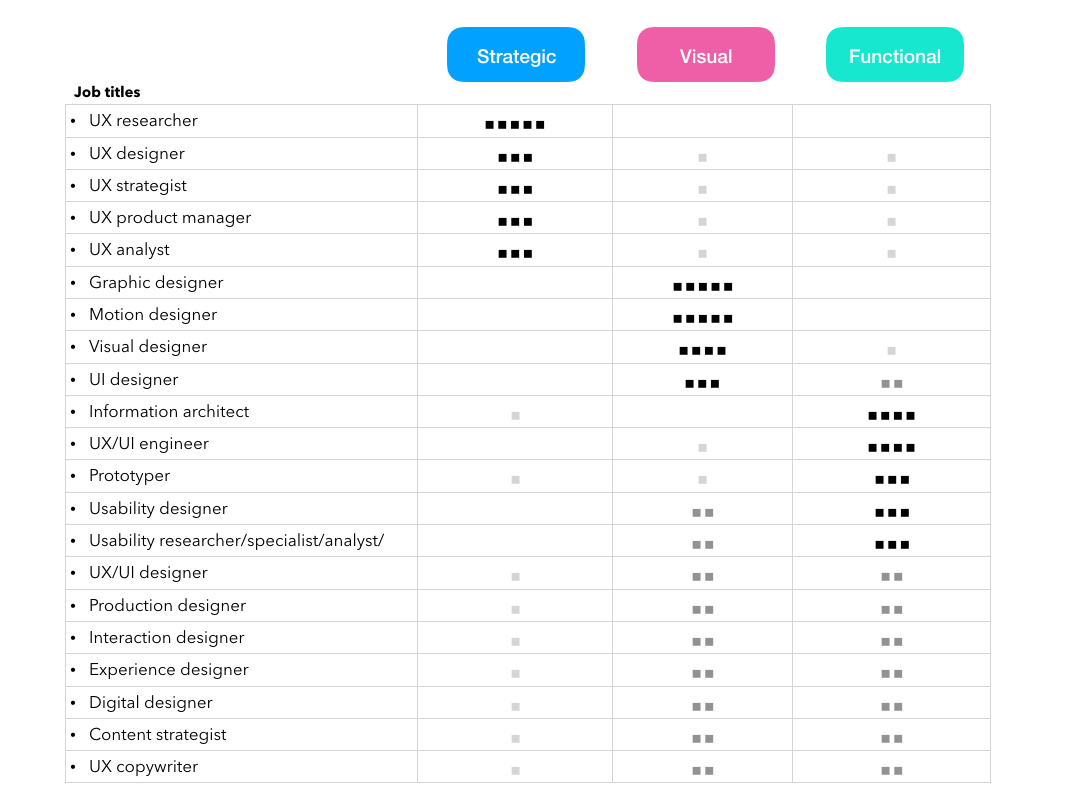
Here’s a matrix from Stephan Takken that I found accurate, which categorizes these roles by their focus:
Tips: the title of the role advertised usually give a good insight into the organization’s UX maturity, where “UI/UX Designer” is preferable by those in the early maturity stage, i.e. still “testing the waters” as to how the role could contribute to product awesomeness, while more mature ones usually prefer specialization like “Interaction Designer”, and “UI Designer”. The more mature it is, the more embedded the designers usually are within the whole product lifecycle, with a seat in the product committee board. (byms)

Leaving a job and what to prepare

“Hope for the best, prepare for the worst.”

So you’ve decided to move on, and take that lavish job offer. Your manager sets you a couple of handovers tasks to do, and what’s left is backing up your personal files before returning your laptop to the IT Department. So you pull up your portable hard drive and backup all of your work conveniently. Easy, right?

Wrong. Your files would most probably be scattered here and there because you mixed them up during the four years of work, so you need to scout through tons of folders to ensure there’s nothing personal left. Before you realize it, time is almost over and you need to stay up late for a couple of nights to ensure everything has been backed up. Sounds familiar?

You could also be in a situation where you keep a somewhat organized record of your stuff, but the early morning meeting with the HRD indicates that this is goodbye and they will revoke your access immediately. Puff! All those insightful notes that you put aside for years, thinking you’ll get to it once you have time in between your crazy schedule, are all gone. Hasta la vista Data!

The truth is, in many cases, the terms of work separation is somewhat outside of your control sphere. Just like any relationship, it could end smoothly, or abruptly, so it’s best to prepare for the worst-case scenario. How? I’m thinking three things, here they are:

01. Make a habit of creating regular back-ups

What should you backup? Think about your “what’s next?” So you can decide what to backup, for example:

  • If you’re a digital product or service designer, and your next job relies heavily on your design portfolio, then create a habit of taking screenshots of your work in progress, including shots of meetings, workshops, which helps to explain the thought process behind your work, will be very helpful (*)
  • If your next role will be somewhat similar to your current one, in terms of challenges and job responsibilities, you want to ensure that learnings from your current work are well recorded so you don’t have to start everything from zero again. Therefore, pieces of notes you took in meetings, workshops, coaching, will be your treasure, make sure to keep those (*)
  • As you learn more about yourself and want to improve, feedback from your colleagues could serve as a reflection of what you did right, and what you need to improve. Some even reveal your blank spots, the things that you don’t know you don’t know. Therefore, the records of your quarterly performance review are something you want to keep as well

02. Taking Notes and Pictures

While most records are available as project deliverables, i.e. presentation slides, final artwork, wireframes, research insights, some you need to produce deliberately, i.e. photo documentations, personal notes, so you need to create a habit of taking pictures and taking notes.

03. Maintain a positive relationship

Last but not least, ensure you maintain a positive relationship with your direct supervisor, e.g. Manager(s), so that they will be there to back you up when your future employer needing a reference.

Got other tips? What usually works the best for you? (byms)

Note:

(1) Be mindful of NDA (Non-Disclosure Agreement) that could get you in trouble if you’re sharing something deemed as sensitive, like a roadmap or business strategy. It’s usually okay though, to keep screenshots and blur out the sensitive details, especially of products that have been launched for public access. When in doubt, check with your supervisor.

Design Portfolio Update, May 2020

One of the most tedious, demanding task for any designer looking for career opportunities, admit it, is updating our portfolio! It’s almost impossible to do while we’re working full-time, (unless you’re already thinking ahead of switching job), yet when we finally have time, without a proper evidence gathering rigorously practised during we’re still employed, it means going back and forth through the whatever archive we can get our hands upon.

I’m glad I did some evidence gathering once in a while which help to give structure to my storytelling, so my current design portfolio update wasn’t that painful.

Still in it’s first draft stage, almost 40 pages long! Yes I will trim it down but that’s stage two, for now this is it, a work in progress:

Click on this link to view it (~7 MB), and let me know what do you think? (byms)

A walk in the fog, innovation attempts during Covid-19 pandemic

Upon navigating the uncertainties presented in this COVID-19 Pandemic, it’s helpful to first, understand the context of the challenge we’re facing, to put things into a clearer perspective. Eddie Obeng through his project classifications divides project types into four quadrants based on the clarity of goals, and clarity of enablers.

Which one accurately fits the situation? As you might have guessed, the answers will be different for everyone depending on their organization’s vision and capabilities. However, for most that caught unprepared, it will be the “Fog”, or “Lost in the fog” – They don’t really know what to do and how to do it.

Further explanation can be found in the book “Managing Unique Assignments: A Team Approach to Projects and Programmes” as follows:

“He calls open projects ‘the walking or lost in the fog type of projects’: ‘you can’t stay in one place, and so it follows that you have to move. According to Obeng, in open projects, you and your interest groups are uncertain. This uncertainty has a bearing not only on what must be achieved but also on how it is to be achieved. In his view, a characteristic of this type of project is that an attempt is being made to do something that has never been done before, for example carrying out a quality-improvement programme or developing an entirely new product for an entirely new market. The approach for these projects depends on the project leader’s skill in continually carrying out the cycle of acting, evaluating and learning from what has been done and then replanning.”

According to Obeng, the right type of leadership for this kind of situation is, you might have also guessed it, “Innovator”. In his book “Perfect Projects”, Obeng mentioned the following traits for such leadership:

  • Build trust – Make promises and keep them
  • Find a wide range of stakeholders many of whom do not initially see themselves as stakeholders
  • Be prepared to go to where team are, logically and emotionally (match and lead)
  • Communicate widely and use questions effectively
  • Listen effectively to both logical and emotional concerns
  • Demonstrate calmness (even when panicking)
  • Describe and capture nature of problem faced
  • Clearly articulate a vision (usually opposite of problem faced)
  • Show genuine concern for team
  • Keep stakeholders informed on a day-to-day basis
  • Encourage team to communicate amongst themselves
  • Capture any learning team makes – Proceed one step at a time
  • Reassure team members – Be creative with any new opportunities or insights which present themselves
  • Give hope to stakeholders – Praise initiative taken by team
  • Provide intellectual challenge through questioning and problem description
  • Analyse complex situations and distil few actions likely to give biggest results
  • Accept offers of ideas and efforts from team
  • Involve team decision making & provide a stable ‘base’

For those reading my previous post about navigating your way in this covid-19 pandemic and thinking to explore the opportunities hidden in this crisis, you will be heavily benefited by the diversity of ideas coming from a team effort, therefore, for someone doing it alone should consider of having allies that can work together to accelerate your wayfinding. (byms)

Moving ahead by creating visibility of your contributions

“How should I ensure that my work and my contributions get visibility within the company? What new skills do I need to move ahead?”

That is among the most used introduction question used in LinkedIn Career Advice, and I think it’s a very legit one: moving ahead has a lot to do with the visibility of your progress.

As an example, when I first joined Traveloka as a Design Lead, I was glad to meet my new team of 20 designers, which is a huge leap from the 2-5 team members I usually lead. I often read that prominent design leaders manage the team even bigger than this, therefore I think I’m on the right track.

What quickly happened though, is the realization that it’s hard to effectively track everyone’s progress.

Despite doing checkups, 1 on 1, and casual daily interactions, it seems there’s always someone that’s eluding attention by being less approachable, avoiding conversations, and stay silent in meetings, perhaps, believing that the less they share, the better it shows that everything is under control.

On the other hand, there are also a few that often popped up and pose conversation like “I need your opinion on this issue”, “Are you available for quick brainstorming?”, or even “I have problem with this stakeholder”.

Who do you think would leave a more memorable impression?

Those that speak up usually get the attention they deserve, why? Because despite their achievements, by speaking up they got to deliver their story, and research has shown that what changes people’s perception is a story, not data.

Do you know what kind of stories is most memorable? Those that provoke the sense of catharsis in its audience, by connecting on the emotional level.

Therefore, to get your contributions visible, there’s no other way than to connect those to your stakeholders’ emotions. Even better, get them as part of the story, and they will be there to defend you when it’s needed, like in the performance review season.

However, storytelling alone won’t cut it. There needs to be real progress within the story. You can only get so far with a mediocre story. Your story needs to tell about a significant contribution.

Therefore, for those still struggling with creating contributions, then ask your leader or coach on where you can create the most impact, as they can help to give you information on what is expected from your role, and how you can better fulfill those expectations. If there’s still a gap in the skills needed, your leader should also be able to assist you in creating an improvement plan.

For leaders, it’s crucial to have a system, and delegation of roles to effectively scale up your influence, therefore creating scalability (and sustainability) in your leadership.

Do you still have questions? Use the comment section below, or connect with me through LinkedIn, Twitter, or Instagram. (byms)

Experience Design Event Calendar 2020

As I lately encountered a lot of event-related informations during my upskilling and network-building, instead of painfully mark it on my persona calendar, I think it will be more useful if I put it in a shareable calendar instead. Doing it this way offers two benefits: Easier to read, as you can view it in either calendar or list view; Gives good sense of time, as it already marks the actual time slots so it reduces the cognitive load to map plain texts into real-time context.

Links:

To add your own design event to this calendar, please invite xdcalendar@gmail.com. (byms)

Career Building Options in COVID-19 Unemployment

Mind map of options for someone unemployed during covid-19 pandemic, by bayuamus.

“ILO estimates are that as many as 25 million people could become unemployed, with a loss of workers’ income of as much as USD 3.4 trillion. However, it is already becoming clear that these numbers may underestimate the magnitude of the impact.”(1)

As the issue of getting laid-off because of the Covid-19 pandemic has become more prominent, getting a new job is tricky, as it could mean changing industry, like doing product design for travel-related service into doing product design for a logistic service; or even shifting your career path altogether, like from doing UX design into service design. While shifting industry usually means adapting your skillset towards a new kind of challenge, the later means there will be a gap to facilitate: the more drastic the change is, the wider the gap is. How to bridge it?

For those finding themselves with no options, what should you do? Maybe you just simply need to look for similarity in a different place, realign your career path, or invent a new opportunity for yourself. How would you accomplish that?

Based on those running questions, I did some mappings about the possible options which combine between self and situation assessment, with branches that consisting of jumping back in, start your own business, or upskilling and education. The nodes incorporated could be a starting point in crafting a more detailed plan, tailored to each one of you.

The next step would be to gather the resources available to support these possibilities, and I have started that earlier in another post, feel free to suggest other resources you’re aware of.

About the mind map itself, do you discover other options or branches? Let me know what do you think in the comment section. (byms)

(1) COVID-19 has exposed the fragility of our economies – http://www.ilo.org/global/about-the-ilo/newsroom/news/WCMS_739961/lang–en/index.htm

Resources for COVID-19 Affected Workers

Image source: ABC News

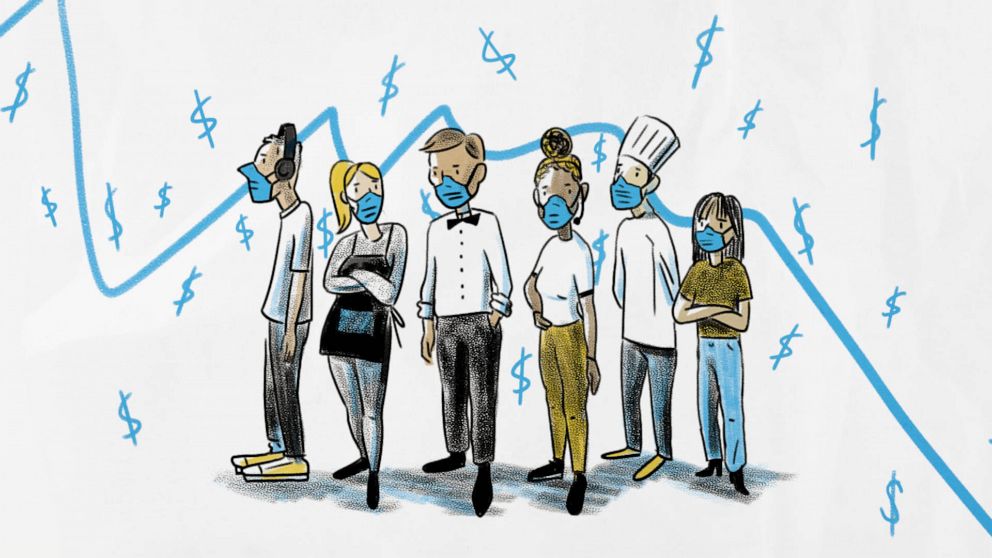
Ever since the #Covid19 pandemic strikes and rapidly affecting the economy, we’ve seen massive amounts of laid-off around the world. People are suddenly out of jobs, which according to the statistics, sets the new level of unemployment.

Thankfully, we’ve also seen amazing efforts from people trying to help with the situation, either in connecting the out of job workers with companies that are still hiring, or facilitating other options like freelancing, entrepreneurship, upskilling, or simply to help ease the traumatic experience.

Looking for a similar job

For those looking for a similar job, the immediate need usually lies in facilitating the job application process, such as ensuring that their CV and portfolio are impactful, and the availability of references from the past workplace. For those going through interviews, help will be much appreciated on tips to improve the candidate’s ability to present themselves, and in rehearsing.

Looking for a different kind of opportunities

Last but not least, as every crisis hold tremendous chances for new opportunities to emerge, therefore mapping and forecasting will help identifying what would be the emerging needs of the “new normals”.

Should anyone is considering to realign their career aspirations, or start their own business, then the availability of related training and how to get funding will help in facilitating the transformation.

Listed below are the resources discovered through the good people in LinkedIn, and various other resources. Kindly reply in the comment should you aware of related resources, your contribution means a lot.

Thank you.


People & Job Listing

SEAriously Awesome People List – Unfortunately, given the changing economic climate, many startups are shutting down or having to lay-off awesome people. Our goal is to surface awesome talent, help folks find new jobs, and help growing startups find top talent ASAP.
#connect #jobboard #southeastasia #Indonesia

Amazing Design People List – Find amazing designers for hire. Discover 1800+ amazing designers worldwide on this community-led talent base during COVID19.
#connect #jobboard #southeastasia #Indonesia

Funding & Finance

Raising during Covid – list of resources for your Startup’s funding
#funding #startup #international

Free Financial Consulting (via Zoom) https://www.linkedin.com/posts/budiraharjocfp_covid19-activity-6656907806161113088-9o5h #finance #planning #Indonesia

Upskilling

Free online learning opportunities, including certification (otherwise costs ~15-50 USD), in response to the pandemic and isolation measures, find it here: https://lnkd.in/gkziCHc

Free online courses from Harvard University- https://www.linkedin.com/posts/talalalmurad_freecourses-covid19-stayathome-activity-6655517782710554625-Ug8t #upskilling #study

Free online courses from Open University https://www.open.edu/openlearn/free-courses/full-catalogue #upskilling #study

Learn German free – https://www.linkedin.com/posts/waitatiri_stayhome-dirumahaja-freecourses-activity-6655473572607287296-MJf5 #upskilling #study #Indonesia

Ivy League universities offer 450 free online courses: https://www.studyinternational.com/news/free-online-courses-ivy-league/

Support

Scholarship for S1 students in Mitra Pertamina Foundation University partners (UGM, UI, ITB, USU, UNDIP, UNAIR, etc.)- https://www.linkedin.com/posts/kinanthi-anindita-b7869b115_beasiswa-pertamina-sobat-bumi-pertamina-activity-6657452884193574912-yzoB #support #study #Indonesia

APD (Tidak) Sekali Pakai

https://www.instagram.com/p/B-ja1kugLu6/?utm_source=ig_web_button_share_sheet

A surprising development from Torch, where they have created a reusable Coverall & Baracoat for medical personnel handling COVID-19 cases, which could replace the “Alat Perlindungan Diri (APD) Sekali Pakai,” therefore greatly reducing the cost of suspected patient handling. Heads to for the details. (byms)

One of the most important skills for Product Designers

Among the most important skills a Product Designer must have, well any kind of designers actually, is the skill of note-taking. It is too often that I witness very good designers got in trouble with their stakeholders due to occasional untimeliness, which after further investigation was caused by they forgot that they have those assignments or missed the details.

In a teamwork setting, such forgetfulness could create a bottleneck that creates a mess, delayed production or last-minute task reprioritization of the development team due to design unreadiness.

Upon note-taking, there are several goals to achieve:

  • Meeting minutes: what are the key takeaways of the discussion?
  • Action points or task: what to do next and by who?
  • Deadline: when it should be done?

While there might be a dedicated note-taker in a meeting, sometimes they fail to capture the details that are related to the individual designer’s role. While the team might also use task management tools like Asana, if it is not updated regularly then some tasks might not be mapped.

Among the tools I found useful for note taking are as follow:

  • Google Keep (Android, iOs, Web) – It’s versatile, simplistic, and accommodate different types of notes. It’s also come from Google meaning it’s easily integrated with other Google products like Google Tasks and Google Calendar
  • Apple Notes (iOs) – It’s simplistic yet powerful, and it comes along most Apple’s devices, e.g.: MacBook, and iPhone
  • Pen and Paper (real world) – good old notebooks that you can carry around, put in your bag, unlimited screen time, no recharging ever needed, timeless

What’s your favourite note-taking tool and why?